You Won’t Believe These Jaw-Dropping Architectural Wonders in Jaipur
Jaipur isn’t just pink—it’s a living canvas of royal grandeur and architectural genius. From majestic forts to intricately carved temples, every structure tells a story. I was stunned by how design and culture merge here. If you’re planning a trip, understanding these architectural marvels will transform your visit from sightseeing to soul-stirring exploration. This is more than a travel guide—it’s your key to truly seeing Jaipur.
The Pink City’s Identity: More Than Just a Color
When travelers speak of Jaipur, the first image that comes to mind is its rosy hue—a blush-colored city glowing under the Rajasthani sun. But the pink façades are far more than an aesthetic choice; they represent a legacy of warmth and welcome deeply rooted in tradition. In 1876, Maharaja Ram Singh II ordered the entire city painted pink to honor the visit of the Prince of Wales, a gesture symbolizing Rajput hospitality. The color, known locally as “gheri,” was traditionally used to welcome esteemed guests, and Jaipur has proudly retained it ever since. Today, the regulation requiring buildings in the old city to maintain this shade ensures that the capital of Rajasthan remains a unified, harmonious visual experience.
Beyond color, Jaipur’s city plan stands as a testament to enlightened 18th-century urban design. Founded in 1727 by Maharaja Sawai Jai Singh II, the city was meticulously laid out in a grid pattern—an unusual concept for Indian cities of that era, which typically evolved organically. Inspired by Vastu Shastra and Shilpa Shastra, ancient Indian architectural texts, the city was divided into nine blocks, representing the navgrahas or nine celestial bodies. This alignment wasn’t merely symbolic; it influenced airflow, sunlight distribution, and ease of navigation. Wide, straight streets intersect at right angles, allowing for efficient movement and ventilation—features that remain practical even in today’s bustling urban life.
Walking through the old city feels like stepping into a living museum. Artisans still practice traditional crafts behind hand-painted wooden doors, and local families maintain centuries-old homes adorned with intricate jharokhas (overhanging balconies) and frescoes. The facades, often painted with floral motifs and mythological scenes, are maintained by skilled artists who inherit their techniques from generation to generation. This continuity of craft gives Jaipur not only architectural coherence but also cultural authenticity. The city’s identity, therefore, is not frozen in time—it breathes, evolves, and remains deeply connected to its origins through every painted wall and planned street.
Amber Fort: Where Power Meets Beauty
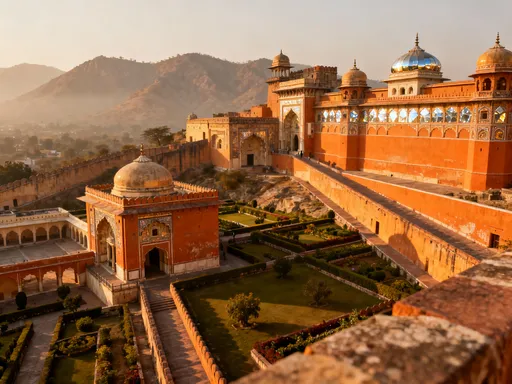
Rising from a rugged hilltop overlooking Maota Lake, Amber Fort is a masterpiece of military architecture and royal elegance. Built in the late 16th century by Raja Man Singh I and expanded over the following decades, the fort combines strength and sophistication in a way few structures can. Its massive stone ramparts, sloping walls, and fortified gateways were designed not only to repel invaders but also to project the power and prestige of the Kachwaha dynasty. The fort’s strategic location—perched on a hill surrounded by hills and water—allowed for early detection of approaching armies and natural defense, making it one of the most secure strongholds in Rajasthan.
Yet, within these formidable walls lies a world of delicate artistry. The fusion of Rajput and Mughal architectural styles is evident in every chamber. The Sheesh Mahal, or Mirror Palace, is a breathtaking example. Walls and ceilings are inlaid with thousands of tiny mirrors, glass pieces, and semi-precious stones that reflect candlelight into a starry illusion. This wasn’t merely decorative; it was a clever way to illuminate private chambers without fire hazards. Even more impressive is the fort’s passive cooling system. Rooms were built with thick sandstone walls, underground water channels, and strategically placed vents that drew in cool air from the lake below. These ancient climate-responsive designs kept interiors comfortable even during the scorching summer months—a testament to the ingenuity of pre-modern engineering.
The fort’s layout also reflects a deep understanding of royal life and ceremony. The Diwan-i-Aam, or Hall of Public Audience, features a high-ceilinged hall with ornate columns where the king met commoners and listened to their concerns. Adjacent courtyards led to private palaces like the Sukh Niwas and Jai Mandir, reserved for the royal family. The network of interconnected palaces, temples, and gardens suggests a lifestyle that balanced governance with leisure, spirituality with luxury. Even the Ganesh Pol, a richly painted gateway leading to the private quarters, is adorned with detailed murals of deities and floral patterns, symbolizing the divine protection of the royal lineage. Amber Fort is not just a monument—it is a narrative in stone, telling the story of a dynasty that ruled with both strength and grace.
Hawa Mahal: The Breath of Royal Privacy
Standing like a delicate honeycomb of sandstone, the Hawa Mahal, or Palace of Winds, is one of Jaipur’s most iconic landmarks. Built in 1799 by Maharaja Sawai Pratap Singh, this five-story structure was designed as an extension of the City Palace, allowing royal women to observe street festivals, processions, and daily life without being seen. At a time when purdah (veil) customs were strictly observed, the Hawa Mahal provided a rare window to the outside world. Its 953 small windows, or jharokhas, are intricately latticed with carved sandstone screens that ensure privacy while permitting airflow and visibility—a perfect blend of cultural sensitivity and architectural brilliance.
The design of the Hawa Mahal is not only symbolic but also highly functional. The latticework allows cool breezes to pass through the structure, naturally ventilating the upper chambers. This passive cooling system made the palace comfortable during Rajasthan’s intense summers, long before the invention of modern air conditioning. The airflow dynamics were carefully calculated—the shape and placement of each window create a Venturi effect, where wind accelerates as it passes through narrow openings, drawing hot air out and pulling cooler air in. This architectural intelligence reflects a deep understanding of environmental design, proving that beauty and utility can coexist in perfect harmony.
Though the Hawa Mahal has no interior rooms in the traditional sense, its façade is structurally supported by a rear wall connected to the main palace complex. This allowed royal ladies to stand behind the screens, watching parades and religious processions from elevated vantage points. The topmost floor offers panoramic views of the bustling bazaars below, where vendors still sell textiles, spices, and handicrafts much as they did two centuries ago. Today, visitors can climb the narrow staircase to experience this view, stepping into the quiet dignity of a bygone era. The Hawa Mahal remains not just a postcard image, but a quiet testament to how architecture can honor tradition while embracing innovation.
City Palace: Tradition in Stone and Space
At the heart of Jaipur lies the City Palace—a sprawling complex that has served as the seat of the royal family for over 300 years. Unlike many palaces turned museums, this one remains partially inhabited, with descendants of the royal family still residing in private sections. This living heritage adds a unique dimension to the site, where history isn’t confined to display cases but continues to unfold in real time. The palace blends Rajput, Mughal, and European architectural influences, reflecting the cosmopolitan vision of its founder, Sawai Jai Singh II, and his successors.
The complex is organized around a series of courtyards, each serving a distinct purpose. The Mubarak Mahal, once a reception hall for visiting dignitaries, now houses a textile museum showcasing royal attire, including intricate zari work and hand-embroidered garments. The Pritam Niwas Chowk, or Courtyard of the Beloved, features four beautifully decorated gates, each representing a different season and dedicated to a Hindu deity—Ganesha, Shiva, Vishnu, and Krishna. These gates are not just ornamental; they reflect the spiritual and seasonal rhythms that governed royal life.
One of the most striking sections is the Chandra Mahal, a seven-storied palace that rises like a wedding cake of pink and white stone. Each floor has a specific function—from the Sukh Niwas (Hall of Rest) to the Shobha Niwas (Hall of Beauty), adorned with Belgian glass, Italian tiles, and mirror work. The topmost floor, the Mukut Mandir, offers a panoramic view of the city and is crowned with a golden pinnacle. While only parts of Chandra Mahal are open to the public, its presence reminds visitors that this is not a relic but a continuing legacy.
The Diwan-i-Aam, or Hall of Public Audience, stands as a symbol of accessible governance. Here, the king would sit in judgment, hear petitions, and address his subjects. The open design, with arched colonnades and a raised platform, ensured visibility and acoustics, allowing even those at the back to see and hear. Today, this space hosts cultural events and exhibitions, bridging the past with the present. The City Palace, therefore, is more than a collection of buildings—it is a living institution where architecture, history, and daily life intersect.
Jantar Mantar: Science as Spectacle
Among Jaipur’s royal monuments, Jantar Mantar stands apart—not as a palace or fort, but as a temple of knowledge. Built by Maharaja Sawai Jai Singh II in the early 18th century, this UNESCO World Heritage Site is an astronomical observatory composed of 19 massive instruments, each carved from local stone. Jai Singh, a scholar-king deeply interested in astronomy, constructed five such observatories across India, but Jaipur’s is the largest and best preserved. What makes Jantar Mantar extraordinary is that it functions without electricity, lenses, or telescopes—yet it could measure time, track stars, predict eclipses, and monitor planetary movements with astonishing accuracy.
The most famous instrument is the Samrat Yantra, the world’s largest stone sundial, standing over 27 meters tall. Its shadow moves at a rate of 4 millimeters per second, allowing it to tell time with an accuracy of up to two seconds. Nearby, the Jai Prakash Yantra consists of two hemispherical bowls with markings that enable astronomers to observe celestial positions from any angle. The Rashivalaya Yantra, a set of 12 zodiac instruments, was used to track the sun’s position in each constellation. These structures are not just scientific tools; they are monumental works of art, blending geometry, precision, and aesthetic harmony.
Jantar Mantar reflects a time when science and spirituality were not separate domains but intertwined aspects of understanding the universe. The observatory was open to scholars of all backgrounds, including Muslim, Hindu, and European astronomers, fostering a spirit of intellectual exchange. Today, guides demonstrate how the instruments work, allowing visitors to stand in the shadow of the Samrat Yantra and experience time in its most elemental form. For families and curious travelers, especially women interested in history and innovation, Jantar Mantar offers a rare glimpse into a world where knowledge was built into the landscape itself.
Hidden Gems: Offbeat Structures with Soul
While Amber Fort and Hawa Mahal draw the largest crowds, Jaipur’s quieter corners hold treasures that reveal the more intimate side of royal life. Sisodiya Rani Bagh, a terraced garden palace built for a beloved queen from the Sisodia clan of Mewar, offers a serene escape. Laid out in Mughal style, the garden features fountains, painted pavilions, and water channels that once carried cool air through the chambers. Murals depicting Krishna and Radha reflect the romantic ideals of Rajput courtly love. Today, it remains a peaceful retreat, perfect for a quiet afternoon away from the city’s noise.
Nahargarh Fort, perched on the Aravalli hills, offers panoramic views of Jaipur’s pink skyline. Originally built as a summer retreat and defense post, it later became a royal pleasure garden. The Madhavendra Bhawan, a series of interconnected suites for the king and his queens, features painted walls and private balconies. Though less crowded than Amber Fort, it provides an equally immersive experience, especially at sunset when the city glows below. The fort also connects via ramparts to Jaigarh and Amber, forming a historic defensive network.
Jaigarh Fort, often called the “Victory Fort,” is home to the world’s largest cannon on wheels, the Jaivana. Built as a weapons foundry, it housed a massive iron furnace and storage for arms. Unlike other forts, Jaigarh saw no major battles, preserving its structures in near-original condition. Visitors can explore the armory, water reservoirs, and royal apartments, gaining insight into the military preparedness of the Rajputs. These lesser-known sites enrich the understanding of Jaipur—not just as a city of beauty, but as one of strategy, romance, and resilience.
Experiencing Architecture: Tips for a Meaningful Visit
To truly appreciate Jaipur’s architectural wonders, timing and approach matter. The best time to visit is between October and March, when temperatures are mild and the skies are clear. Early mornings offer soft light that enhances photography, especially at Hawa Mahal and Amber Fort, and helps avoid the midday heat. Arriving at opening time also means fewer crowds, allowing for a more reflective experience.
Hiring a certified local guide can transform a casual tour into a meaningful journey. Knowledgeable guides provide context about construction techniques, historical events, and cultural practices, turning stone walls into living stories. Many speak multiple languages and tailor tours to family interests, making them ideal for women traveling with children or elderly parents. Audio guides are available but lack the personal touch and spontaneity of a human narrator.
Consider thematic routes to deepen understanding. A “water and climate” tour could include the underground tanks of Amber Fort, the wind channels of Hawa Mahal, and the stepwells near Nahargarh, showcasing how architecture responded to Rajasthan’s arid environment. A “royal life” trail might connect the private chambers of City Palace, Sisodiya Rani Bagh, and Madhavendra Bhawan, revealing the personal side of monarchy. Combining sites by proximity—such as Amber, Jaigarh, and Nahargarh in one day—also saves time and energy.
Respect is essential when visiting active heritage sites. Dress modestly, avoid touching delicate carvings or paintings, and follow photography rules, especially in private or sacred areas. Remember that some spaces are still used for ceremonies or royal functions. By approaching these sites with curiosity and reverence, travelers honor not just the past, but the living culture that continues to cherish them.
Jaipur’s buildings are not relics—they’re voices of a living culture. By engaging with their design, history, and purpose, travelers gain more than photos; they gain perspective. Let your journey through Jaipur be one of wonder, understanding, and deep connection.